
Summary of the Article
Kickboxing classes come in two broad types: technical classes that teach you to strike, defend and counter, and fitness kickboxing classes that use kickboxing movements as a workout. A first session is usually a warm-up, some basic stance and technique, and pad or bag work. You will not spar, and most gyms lend you gloves, so there is nothing to buy before you try.
Technical kickboxing (Dutch/K-1 style): punches, kicks and defence, taught with partner drills
Muay Thai: the same striking base plus elbows, knees and clinch work
Fitness kickboxing: a cardio workout with no contact and little defensive skill
London prices (checked November 2026): roughly £12 to £22.50 per class, £60 to £135 a month, or £125 to £200 for a beginner course
The best gym for a beginner has experienced coaches, a beginner pathway, loaner gloves and a free or cheap trial
What a Kickboxing Class Actually Is
A kickboxing class teaches you to punch, kick, defend and move. You learn a stance, a guard, and how to throw strikes with control. Along the way you build fitness, strength, endurance, flexibility and cardio, because the training itself demands all of them.
People start for all sorts of reasons. Some want self-defence. Some want to get fit without staring at a treadmill. Some watched one too many fight videos and want to try it themselves. All of those are fine starting points.
Before anything else, you need to know the single most important choice, because gyms use the word "kickboxing" to mean two very different products:
Technical kickboxing is a martial art. You learn real striking skill, usually with partner drills on pads.
Fitness kickboxing is a workout. You follow along, hit bags or air, sweat hard, and never make contact with another person.
Neither is wrong. But if you show up to one expecting the other, you will be disappointed. The rest of this guide shows you how to tell them apart and how to pick a gym with confidence.
The Three Styles You Will See on London Timetables
Most classes labelled "kickboxing" in London sit in one of three camps.
Dutch/K-1 style kickboxing is what most fight gyms mean by the word. It combines boxing-style hands with kicks, including low kicks to the leg. It has no elbows and very little clinching, which keeps the sport at striking range. As Kaizen MMA's comparison of the two sports puts it, most kickboxing rulesets ban elbows and shorten or remove the clinch, while Muay Thai keeps both.
Muay Thai is Thailand's national sport, sometimes called the art of eight limbs: two fists, two elbows, two knees, two shins. It adds the clinch, which is standing grappling where you control an opponent's posture and land knees. If you want the most complete standing martial art, this is it. If you only want punching and kicking, a straight kickboxing class covers that too.
Fitness or cardio kickboxing borrows the movements for exercise. As Dragon Gym's explainer notes, the goal is heart rate and calorie burn, techniques are simplified and repeated, and there is no sparring or combat application in a typical class. It is a legitimate workout, but it will not teach you to defend yourself.
Dutch/K-1 kickboxingMuay ThaiFitness kickboxingWhat you learnPunches, kicks, low kicks, defence, countersThe same base, plus elbows, knees and clinchKickboxing movements as exerciseContactControlled partner drills; sparring optional laterControlled drills; clinch work as you progressNoneBest forLearning to strike and defendThe complete standing martial artGetting fit and burning off stress
How do you tell which one a gym teaches? Check the class description for words like "sparring", "clinch" or "grading", or simply ask: do you teach low kicks, do you use knees, and do beginners drill with partners? The answers tell you exactly what kind of class it is.
What Happens in Your First Class
First sessions follow a similar shape across London gyms, and knowing the outline removes most of the nerves.
Arrive 10 to 15 minutes early. You will fill in a short form, meet the coach, and mention any injuries. Coaches expect first-timers; they see them every week.
Warm-up. Expect skipping, mobility work or light cardio for five to ten minutes.
Stance and guard. The coach shows you how to stand, hold your hands and move your feet. Everyone starts here.
Basic punches and kicks. Usually a jab, a cross and a simple kick, practised slowly at first.
Pad or bag work. You hit focus mitts held by a partner or the coach, or work a heavy bag. This is the part most people love.
Cool-down. A short stretch, then the coach will tell you what to try next.
Two things beginners worry about are simply not there. Sparring is never part of a first class, and you will not be asked to fight anyone. Gyms such as Paragon Gym in Shoreditch run dedicated beginner courses that teach fundamentals in a structured way and welcome all fitness levels, and that pattern is standard across the city.
What to Wear and Bring
Keep it simple:
Comfortable sportswear: a t-shirt or rash guard and shorts or leggings
Trainers, unless the gym trains barefoot on mats (ask when you book)
A water bottle and a small towel
Do not buy gloves or hand wraps before your first session. Good gyms loan them to beginners. BoxcleverLDN on Kensington High Street tells first-timers explicitly that gloves and wraps are lent out, so nobody needs to spend money before trying a class. Buy your own kit later, once you know you are hooked.
Do You Need to Be Fit, or Young, to Start?
No, on both counts.
You do not need to be fit to start kickboxing, because kickboxing is how you get fit. Coaches scale every drill. If you need to pause during the warm-up, you pause. If a combination is too complex, the coach gives you a simpler version. Complete beginners share the same class as people in their second year all the time.
There is no upper age limit either. Adults start in their 30s, 40s, 50s and beyond, and the people-also-ask questions around this topic ("is 30 too old?") say a lot about who is searching. Thirty is not too old; plenty of people start well past it. The realistic rule is: if you can climb a flight of stairs without stopping, you can try a beginner class. If you have a health condition or an old injury, mention it to the coach and your GP first.
Is Kickboxing Safe for a Beginner?
Kickboxing is a contact sport in its full form, so honest gyms talk about risk rather than pretending it does not exist. But beginners are the most protected people in the room.
Good coaching manages risk in specific ways: you drill techniques in the air or on pads before anything else, partner work is controlled and light, sparring does not happen until you have the fundamentals and choose to try it, and equipment (gloves, wraps, gumshields) exists for exactly this reason. Sparring is always optional. Many long-time members never spar and simply enjoy the technique, the pads and the fitness.
The most common beginner injuries are sore muscles and the occasional bruised shin from a missed pad, not anything dramatic. Train at a structured gym and the risk stays proportionate.
How to Choose a Kickboxing Gym: a Beginner's Checklist
Use this list to compare any gym in London, including ours.
Coach credentials. Are the instructors named on the website with real kickboxing or fight experience, and do they personally correct beginners?
A structured beginner pathway. Look for a beginner course or fundamentals route, not just "all levels" classes where newcomers are expected to keep up.
Level-split classes. Beginners should train with beginners, at least at first.
Loaner equipment. Gloves and pads should be provided or loaned so you can start without buying anything.
Transparent pricing. Prices published on the website, with no hidden joining or licence fees.
A free or cheap trial. You should be able to try before committing.
Honest answers about sparring. Ask directly: when does sparring start, and is it optional? A good gym answers plainly.
Schedule and location. Check the timetable against your week and the travel time. A gym 50 minutes away is a gym you will stop attending.
Atmosphere. Judge it on the trial. You want welcoming, not intimidating.
Common Beginner Worries, Answered
Will I get hit?
Not unless you choose to. Beginners hit pads and bags, never people. Sparring is a later, optional step, and even then it is controlled and consented to.
I am worried I will feel out of place
Everyone in the beginner section of the class was new once, usually recently. The interesting thing about martial arts gyms is that skill, not appearance, earns respect, so the least experienced person gets the most patience, not the least.
How long does it take to learn?
You will feel competent with the basics in a few months of consistent training: a workable stance, clean basic combinations, decent fitness. Real skill takes years, but the enjoyable part starts almost immediately. Three months of regular classes is enough to know whether the sport is for you.
What if I miss a session?
Nothing bad. Progress in kickboxing comes from months, not single weeks. Most gyms offer multiple beginner sessions a week or a way to make up a missed class, so an odd missed session costs you very little.
If you are weighing up a first visit, our own FAQ page covers common first-visit questions too.
Kickboxing and Brazilian Jiu-Jitsu: Why People Train Both
If you are exploring martial arts generally, it helps to know how the two main formats differ. Kickboxing is a standing art: striking, defence, counters and set-ups. Brazilian Jiu-Jitsu (BJJ) is a ground art: grips, control, escapes and submissions, without strikes.
They complement each other neatly. Kickboxing gives you confidence at range and serious conditioning. BJJ teaches you what to do if a situation ends up on the floor. Many people train both, using one as their fitness workout and the other as their technical focus, or alternating by season. If that mix sounds interesting, browse the academy's classes to see how the two programmes sit side by side.
Trying Kickboxing at the Roger Gracie Academy in Hammersmith
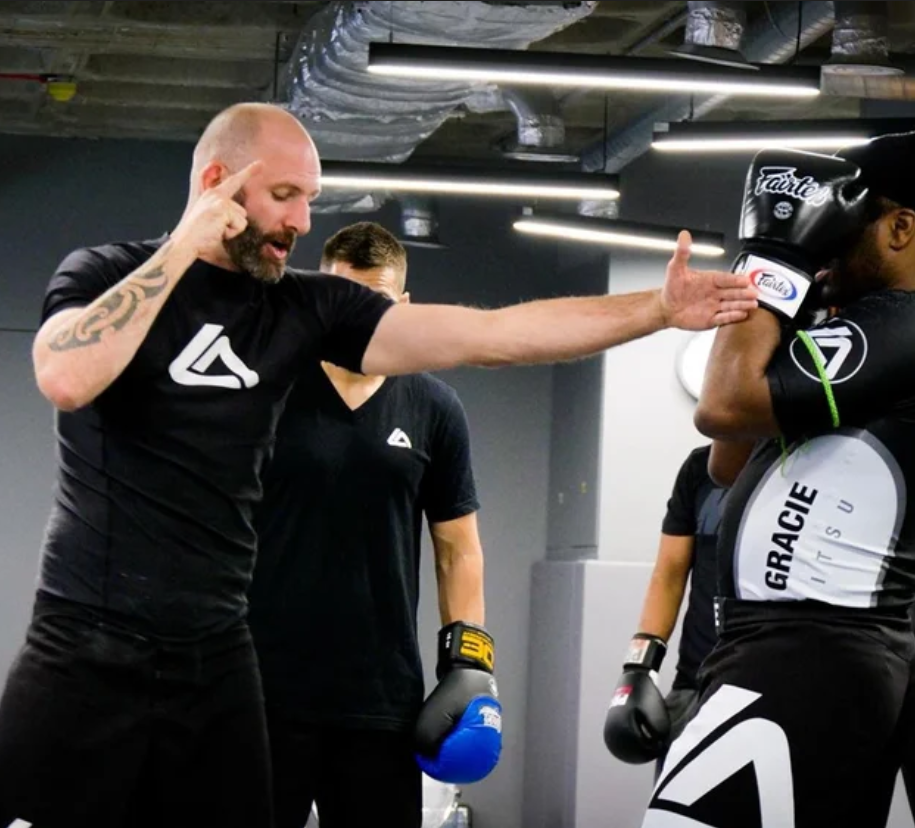
As one worked example of the checklist above: the Roger Gracie Brazilian Jiu Jitsu Academy is based in Hammersmith, West London, and offers kickboxing classes for complete beginners as well as experienced participants. The kickboxing programme teaches striking, defence, counters and set-ups, and like all martial arts training at the academy it builds fitness, strength, endurance, flexibility and cardio.
You can judge the gym on a trial rather than a promise: the academy offers a free trial class, and if you are visiting London temporarily, visitor passes let you drop in for kickboxing sessions while you are in town.
A note on scope: this academy is first and foremost a BJJ academy that also runs kickboxing, so if ground fighting is your main interest, the same gym covers that too. For current kickboxing session times, check the class timetable rather than guessing from any article, including this one.
Next Steps
Between deciding and your first class, three small steps make the difference:
Shortlist two or three gyms within easy travel of home or work, and score them against the checklist above.
Ask the two questions that reveal the most: "do beginners spar?" and "can I try a class first?" The answers tell you almost everything about the gym's culture.
Book the trial. Put it in your calendar. A trial you keep rescheduling is a decision you have already made.
If the Roger Gracie Academy fits your side of London, the simplest way to act on this guide is to book a free trial class. Come along, meet the coach, hit some pads, and see whether kickboxing earns a place in your week.