
Summary of the Article
Gi and No-Gi classes teach the same core jiu-jitsu. A gi class adds a heavy uniform with collar, sleeve, and trouser grips, which slows the game down and rewards patience and precision. A No-Gi class drops the uniform, so you control your training partner with underhooks, wrist control, and body position, and the pace climbs.
Gi class: slower and more tactical. Great for learning positions carefully and for collar-and-sleeve technique.
No-Gi class: faster and more athletic. Great for scrambling, wrestling-style takedowns, and MMA-style grappling.
Most beginners: pick the format you will actually attend every week, then book a trial class and feel the difference for yourself.
If you train in Hammersmith or West London, the Roger Gracie Academy runs both formats, from beginner sessions up to competition training, so you never have to pick a gym based on this choice. You only have to pick a starting point.
What Actually Changes Between Gi and No-Gi
The techniques you learn in your first months overlap heavily in both formats. What changes is how you hold someone down and how fast positions move.
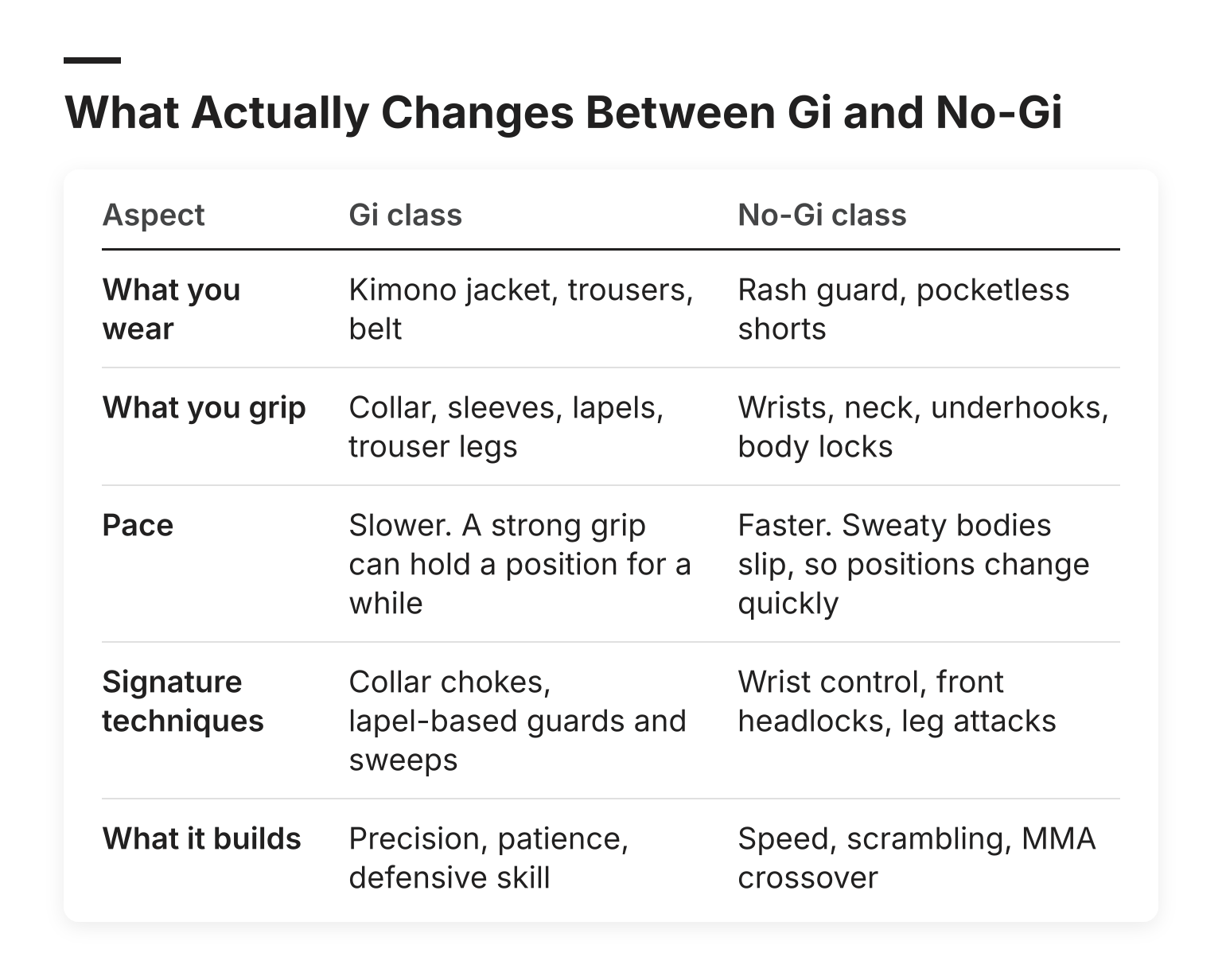
Everything else, like base, frames, guard, escapes, control, and submissions, transfers between the two. Think of them as two dialects of the same language, not two different martial arts. As the Melbourne Jiu-Jitsu Academy puts it in their beginner guide, gi is a bit like chess with extra pieces: the fabric grips slow things down and create more control options, while No-Gi rewards timing and hip movement.
What Happens in a Gi Class
The gi (also called the kimono) is the heavy woven jacket and trousers most people picture when they think of jiu-jitsu. Because both people wear one, you get a huge number of handles. A grip on the collar can break someone's posture. A grip on the sleeve can steer their arm straight into an attack. Grips on the pants control the legs.
That friction does two useful things for a beginner:
It slows the pace. A good grip acts like a brake. Positions last longer, so you get more time to think, react, and understand why something worked.
It teaches grip defence early. Breaking grips, hiding your sleeves, and protecting your collar become habits from week one.
The gi also unlocks techniques that simply have no No-Gi equivalent. Cloth chokes like the cross collar choke and the bow and arrow choke use the jacket itself. Guard styles like spider guard depend entirely on sleeve grips. If those sound appealing, a gi class is where you learn them.
The tradeoff is comfort and cost. A gi is a jacket in a hot room, and you need one to train. Ask the academy before your first session whether a loaner gi is available for trial classes, so you are not buying kit before you know you like the sport.
What Happens in a No-Gi Class
No-Gi means grappling without the uniform. You wear a fitted rash guard and shorts, and because there is no fabric to grab, every grip has to come from the body itself: underhooks, overhooks, collar ties, wrist control, and body locks.
Two things follow from that:
The pace rises. Sweat removes friction, so holds that would stick in a gi slide away. Rounds carry more scrambles, more escapes, and more moments where neither person has control.
Wrestling moves matter more. Takedowns, leg attacks, and front headlocks like the guillotine and the d'arce take centre stage, which is one reason No-Gi sits close to MMA grappling.
Some No-Gi rulesets allow more leg locks than gi divisions, though the exact rules change between organisations and belt levels, so beginners should keep the detail light and trust their coach on what is appropriate for their level.
The tradeoff is that the speed can feel chaotic at first. Without handles, you learn control through angles and body structure rather than through your hands, and that takes a few sessions to click.
What Stays the Same in Both Formats
Strip away the uniform and the core of Brazilian jiu-jitsu does not budge. In both classes you will work on:
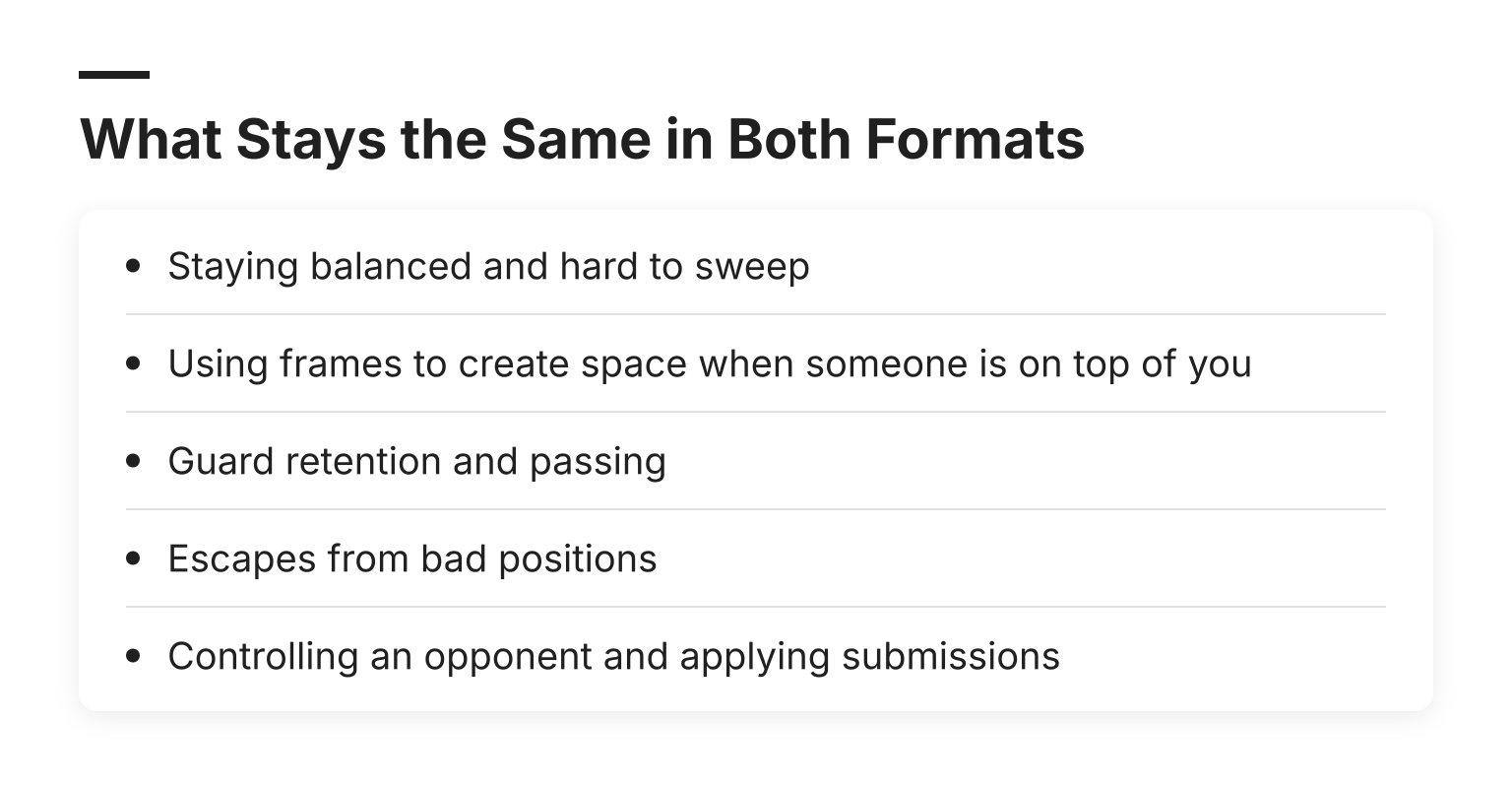
This is why many students eventually train both, and why the choice of your first class is less final than it feels right now. Skills you build in one format show up in the other.
Which Class Fits You
There is no universal right answer. A useful way to decide is to match the format to your background and your reason for training.
Complete beginner. Many gyms suggest starting in the gi, because the friction slows rounds down enough to learn positions before speed takes over. But several experienced academies argue the honest answer is simpler: start with whichever class you will attend consistently. If a No-Gi session fits your schedule and sounds more fun, that consistency beats a theoretical advantage.
Ex-wrestler or MMA-curious. No-Gi will feel familiar straight away. The grips, scrambles, and takedowns map closely to what you already know, so you can skip a step.
Fitness-first student. Both formats are a serious workout. No-Gi tends to spike the heart rate with scrambles, while gi rounds build endurance through constant grip fighting and pressure. Pick by preference, not by calorie claim.
Kids and teens. The gi gives coaches clear control points for teaching structure, and it makes the game slower and safer for small bodies. If you are choosing for a child, look at the kids martial arts classes on offer and ask which format the children's sessions use.
Visitor to London. If you train elsewhere and are in town for a few days, pick the format you already train and check whether a visitor pass fits your trip. If you do not train at all, either format works as a one-off experience, and a trial class is the easiest way in.
What to Wear to Your First Class
For a gi class, you need a gi. Many academies lend one for a first session, so ask when you book rather than buying one blind. Under the jacket you can wear a plain t-shirt or rash guard, and it is worth trimming your nails and removing jewellery before you step on the mats.
For a No-Gi class, wear a rash guard or fitted t-shirt with shorts that have no pockets, zippers, or buttons. Bare feet on the mats, shoes off at the edge, and the same hygiene basics apply either way: come clean, keep nails short, cover any cuts.
If you plan to compete later, note that tournament attire is stricter than class attire. The IBJJF, the sport's largest federation, specifies gi colours, sizes, and No-Gi clothing rules in detail on its uniform requirements page, which is worth reading once competition becomes a goal rather than a first-class worry.
Why Many Students Eventually Train Both
Ask long-term students and you will rarely find a gi-only or No-Gi-only loyalist for long. The common path looks like this:
Start in fundamentals classes in one format and get comfortable.
Add the other format once basic positions and escapes feel natural.
Let each format fix the other's blind spots. The gi punishes lazy defence, No-Gi punishes slow reactions.
Because our No-Gi programme runs at beginner, all-level, open-mat, and competition levels alongside the gi schedule, you can make that transition inside the same academy without changing gyms.
How to Choose Using the Timetable
A typical fundamentals class follows the same structure in either format: a warm-up, technique demonstration, drilling with a partner, and some form of supervised sparring. That predictability makes your first session easy, whichever format you pick.
The practical decision is therefore about time, not technique. Look at the BJJ class timetable and see which Gi and No-Gi sessions actually fit your week. Then compare it with the full range of classes we offer, including kids martial arts and kickboxing, if you are choosing for the family rather than just yourself.
If questions remain, like what a first class involves or which session to try first, the academy's FAQ page covers the common ones.
Book Your First Class and Feel the Difference
Reading about grips and pace only gets you so far. The fastest way to settle the Gi versus No-Gi question is to try one, or both, on the mats.
Book a free trial class at our Hammersmith academy, and mention which format you would like to start with so we can confirm attire for your session. When you are ready to make training a habit, the membership sign-up process takes just a few minutes.